
-1.png?width=2000&height=893&name=MICA%20Tech%20LOGO%20(1)-1.png "MICA Tech LOGO (1)-1")
Why Beijer Electronics?
MICA Technologies exclusively reps Beijer Electronics HMIs, and there is a good reason
-1.png "Beijer HMI banner (why Beijer)-1")
How did we find Beijer Electronics?
The foundation of MICA Controls and MICA Technologies was built on solving real-world challenges in industrial automation. Early in their careers, our founders were responsible for developing process control and compressor systems deployed globally—each project requiring integration with different customer-specified PLC platforms. Every system needed its own custom manual to explain how to interface with the specific PLC. In addition, each PLC had to be paired with a corresponding HMI, and each HMI came with its own capabilities, resolutions, color schemes, and functionality. This created a significant inefficiency: every system required unique HMIs, custom interfaces, and entirely new documentation to guide operators on how to interact with each specific PLC. This meant that engineers had to repeatedly create new graphics and documentation for every project. The result was increased engineering time, higher costs, and unnecessary complexity for both the business and its customers.
Frustrated by this ongoing issue and determined to find a better approach, our founders searched for a more flexible and standardized solution—and discovered Beijer Electronics in 2001. What set Beijer apart was its open architecture and unmatched driver support, allowing HMIs to communicate with virtually any PLC without additional software, licensing, or proprietary constraints. This meant a single, well-designed application could be deployed across multiple projects and geographies, regardless of the underlying control system. By eliminating the need for custom graphics and documentation for every installation, Beijer HMIs enabled true standardization—streamlining engineering, reducing costs, and delivering a consistent, high-quality user experience. This is why, to this day, Beijer remains a core part of the solutions we trust and deliver to our customers.
What makes Beijer our number one choice for our own projects?
MICA Controls LTD. prefers to use Beijer HMIs in their project for a multitude of reasons.
Here are the highlights that our engineers have shared:
-
Multi-Protocol Connectivity – Seamlessly communicate with a wide range of PLCs and systems using extensive built-in drivers.
-
Protocol Conversion Built-In – Bridge communication between different PLCs and protocols directly through the HMI.
-
Fast Tag Integration – Easily import/export tags via Excel to accelerate setup and reduce manual work.
-
Powerful Offline Development – Use the iX Developer simulator to build, test, and communicate with PLCs—no physical HMI required.
-
Instant Testing & Updates – Run and validate changes immediately on your computer without downloading to hardware.
-
Scalable Across Devices – Develop once and deploy across multiple HMI sizes and X2/X3 models without rework.
-
Cost-Effective Licensing – One-time software purchase per development PC—no per-device licensing required.
-
Advanced Alarming & Data Logging – Built-in tools for real-time monitoring, alarms, and long-term historian data.
-
Reusable Development Tools – Copy, paste, and reuse objects with aliasing to speed up engineering across similar systems.
-
Efficient Multi-System Design – Ideal for projects with repeated equipment or multiple trains—build once, deploy many.
-
Flexible & High Performance – Suitable for both simple interfaces and complex, data-driven applications.
-
Multi-Language Support – Easily switch languages (e.g., English/French) for global or Canadian deployments.
The Software That Makes a Difference

iX3 HMI software
Streamline your HMI design with iX, featuring top-tier graphics, intuitive operation, and extensive connectivity.

WebIQ software
Create responsive, web-based HMIs effortlessly with drag-and-drop widgets and powerful visualization tools.
Why do we keep using Beijer Electronics?
Beijer Electronics advances industrial cybersecurity with the X3 HMI series and iX3 software.
Beijer Electronics is committed to delivering a secure‑by‑design HMI platform that meets the evolving demands of industrial cybersecurity. With the X3 series, OS3, and iX3 software, customers gain a future‑proof foundation built on standards, hardened architecture, and continuous investment in secure development.

A cybersecurity‑first HMI platform
The X3 series is engineered around three pillars: cybersecurity integration, high quality and ease of use. The platform is designed to meet the requirements of IEC 62443‑4‑2 and aims to support Security Level 2 (SL2), ensuring that X3 HMIs are ready for modern OT security demands. The X3 HMIs further strengthen this foundation with hardened communication, encrypted data handling, and controlled system interfaces.
Secure development aligned with IEC 62443
Beijer Electronics is implementing the IEC 62443 standard across its development processes and product portfolio. Key initiatives include:
-
Secure development lifecycle aligned with IEC 62443‑4‑1
-
X3 series designed for IEC 62443‑4‑2 compliance
-
Secure boot, hardened OS architecture, and authenticated access
-
Encrypted communication and controlled ports
-
This ensures that cybersecurity is embedded from design to deployment.
OS3: A modern and secure operating system
The OS3 operating system provides a hardened foundation for the X3 series:
- Secure data transfer and user management
- Integration with enterprise identity systems such as Active Directory
- Support for two‑factor authentication and single sign‑on, through Entra via AD.
- OS3 strengthens both operational security and IT/OT alignment.
iX3 software: Secure, scalable HMI engineering
The iX3 platform introduces a new generation of secure HMI development:
-
Integrated alarms, trends, recipes, and data logging
-
Advanced customization through C# scripting and NuGet packages
-
Enterprise‑ready authentication with AD, MFA, and SSO
-
Secure upgrade path from iX2 to iX3 without rebuilding projects
Together with OS3, iX3 provides a secure, modern environment for both engineering and runtime.
Encrypted communication and system integrity
Security capabilities across the X3 ecosystem include:
- Encrypted communication between devices and systems
- Role‑based access control and user authentication
- System integrity protection and controlled communication ports
- Event logging for traceability and compliance
These features ensure safe deployment in connected industrial environments.

Secure hardware foundation
The X3 series combines cybersecurity with robust industrial design:
- High‑performance hardware for stable, secure operation
- Certifications including UL, CE, UKCA, KCC, FCC, and marine approvals
- Rugged X3 extreme variants with ATEX/IECEx certifications
Physical durability reinforces digital security.
Designed for secure IT/OT convergence
The X3 platform supports modern, connected architecture:
- New web browser and web server functionalities
- Docker container support for isolated applications
- WebIQ for secure HTML5‑based HMI experiences
- Secure drivers for major PLC brands
- IX new HTML 5 browser which is encrypted
This enables secure integration into digitalized industrial systems.
| Feature / Capability | Beijer X3 HMIs | Siemens SIMATIC HMI | Rockwell PanelView / Optix | Schneider Harmony HMI |
|---|---|---|---|---|
| PLC Compatibility | ✅ Works with virtually any PLC via extensive driver library | ⚠️ Best with Siemens PLCs (TIA Portal ecosystem) | ⚠️ Optimized for Allen-Bradley / Logix | ⚠️ Optimized for Schneider / EcoStruxure |
| Multi-Protocol Communication | ✅ Native multi-protocol + protocol conversion capabilities | ⚠️ Limited outside Siemens ecosystem | ⚠️ Strong within Rockwell ecosystem | ⚠️ Primarily Schneider-focused |
| Development Software | ✅ iX Developer (flexible and modern) | ⚠️ TIA Portal (powerful but Siemens-specific) | ⚠️ FactoryTalk / Studio 5000 (ecosystem-bound) | ⚠️ EcoStruxure tools |
| Open Platform / Flexibility | ✅ Open architecture with C#, Docker, web apps | ⚠️ More closed, Siemens ecosystem | ⚠️ More closed, Rockwell ecosystem | ⚠️ Semi-open, but ecosystem-driven |
| Project Reuse & Scalability | ✅ Develop once, deploy across multiple screen sizes/models | ⚠️ Scalable, but less emphasis on reuse across platforms | ⚠️ Model-dependent | ⚠️ Limited cross-platform reuse |
| Simulation & Offline Development | ✅ Full simulator—develop and test without hardware | ⚠️ Available but more tied to Siemens workflow | ⚠️ Available but less emphasized | ⚠️ Available depending on tools |
| Ease of Integration | ✅ Designed for mixed-vendor environments | ⚠️ Best within Siemens systems | ⚠️ Best within Rockwell systems | ⚠️ Best within Schneider systems |
| Data Logging & Alarming | ✅ Advanced built-in historian, alarms, trends | ✅ Strong capabilities | ✅ Strong capabilities | ✅ Strong capabilities |
| Development Efficiency | ✅ Excel import/export, aliasing, reusable objects | ⚠️ More engineering overhead | ⚠️ More engineering overhead | ⚠️ Moderate efficiency |
| Multi-Language Support | ✅ Built-in, easy switching (e.g., English/French) | ✅ Supported | ✅ Supported | ✅ Supported |
| Rugged / Industrial Environments | ✅ Marine, hazardous areas, extreme conditions | ✅ Industrial variants available | ⚠️ Less emphasis on extreme environments | ⚠️ Varies by model |
| IT / Security Features | ✅ AD, MFA, SSO, IEC 62443 support | ⚠️ Available but not highlighted here | ⚠️ Available across ecosystem | ⚠️ Available across ecosystem |
| Cost Structure | ✅ One-time software license per developer | ❌ Licensing tied to ecosystem/tools | ❌ Licensing tied to ecosystem/tools | ❌ Licensing tied to ecosystem/tools |
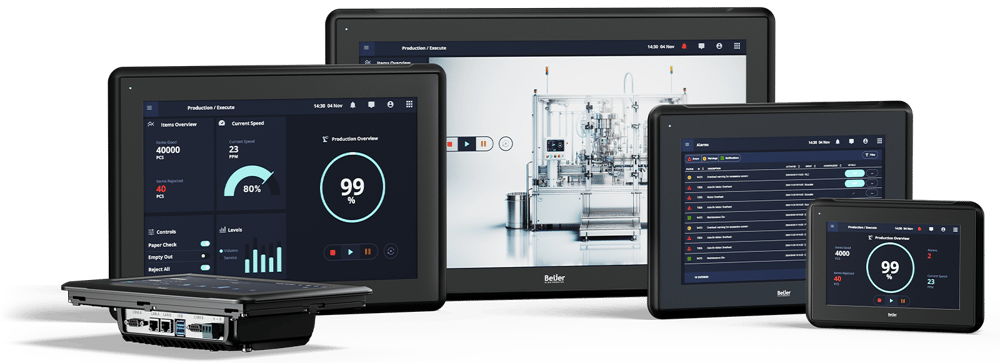
X3 - The Future of HMI. Now.
The Next Generation
Experience the innovation of the X3 series, designed to enhance your human-machine interface experience.
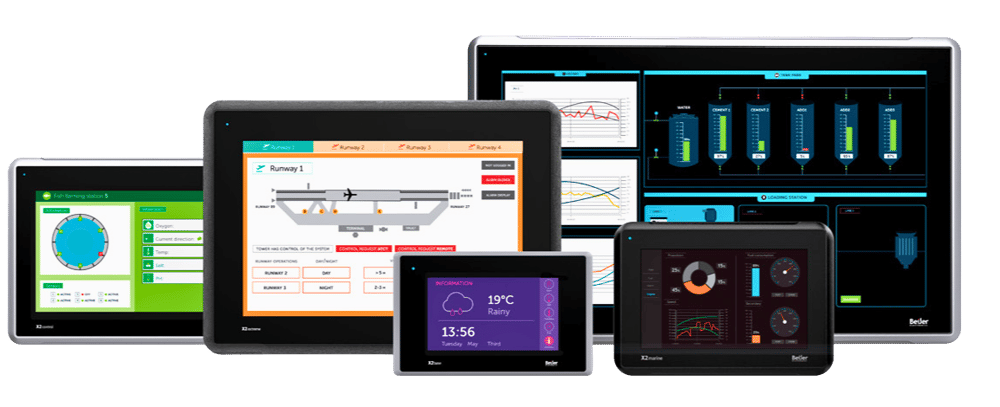
X2 - A Match for Every Requirement
Customer-proven. Industry-driven
Robust performance, intuitive interfaces, and seamless integration, ensuring efficient operations and enhanced user experience.