.png?width=301&height=136&name=MICA%20Controls%20no%20background%20(301%20x%20136%20px).png "MICA Controls no background (301 x 136 px)")
Seeing Through the Heat: MICA's Approach to Flame Detection
TL;DR: Flame detection is a make-or-break function in any burner management system (BMS)—the difference between a controlled shutdown and a catastrophic failure. MICA Controls has spent years matching detection technology to the punishing realities of fired equipment, from crowded heat recovery steam generators to acid-gas sulfur recovery units to reformer penthouses hot enough to melt boot glue. The lesson across every project: there's no universal flame scanner, only the right technology for the right problem.
In a burner management system, flame detection isn't a formality. It's the mechanism that confirms a burner is safely lit and keeps watching for the moment it isn't. Get that wrong, and unburned fuel or process gas can keep flowing into a firebox that no longer has a flame in it—a scenario that ends badly, fast.
MICA Controls has spent years working with flame detection technology across nearly every fired equipment application, including projects where the company was called in to replace legacy equipment that failed operators when it mattered most. That experience has produced a clear conviction: picking the "right" flame scanner was never about brand loyalty or a spec sheet. It's about matching detection technology to the punishing realities of the application in front of you.
This post covers what flame scanners actually do, why selecting the right one is harder than it looks, and how MICA Controls solved this problem across three very different, demanding environments.
What Does a Flame Scanner Actually Do in a BMS?
A flame scanner has one job: confirm that a burner is safely lit, then keep monitoring continuously for flame loss during operation. That sounds simple. The consequences of getting it wrong are not.
Take a sulfur recovery unit (SRU) as an example. If a flame is lost and the air blowers keep running, that air reacts with the elemental sulfur sitting in the beds. Temperatures take off, and in the worst case, the plant burns down. The root cause is almost always the same: the flame was lost, nobody knew it, and the logic system didn't react in time.
A flame scanner's answer is binary—flame or no flame. But the technology producing that binary answer is far from simple, and the wrong choice can turn a safety device into a liability.
Why Is Choosing the Right Flame Scanner Harder Than It Looks?
It's tempting to assume one scanner technology works everywhere. It doesn't. Three variables complicate flame detection on almost every project: extreme heat, unconventional flame types, and space constraints in already-crowded facilities.
Conventional UV and IR scanners are reliable in standard applications. They struggle, or fail outright, once conditions turn non-standard—acid gas flames that don't behave like natural gas, or high-radiant-heat environments that push electronics past their limits.
MICA Controls' approach isn't to search for a universal scanner. It's to diagnose the application first and let the physics of that specific environment dictate the technology.
Solving Detection Challenges in Heat Recovery Steam Generators
On one HRSG project, cost and space were the binding constraints. Multiple burners each required redundant scanners, and the client was already paying full price for an upgraded scanner solution.
MICA Controls introduced a lower-cost detection alternative that delivered the same reliability at roughly a half of the price. That savings mattered: with 10 burners per HRSG and 2 scanners per burner, the costs of full redundancy add up quickly. The savings freed up budget for additional scanners rather than forcing a compromise on fewer.
The engineering benefits went beyond price. A smaller footprint made the scanners easier to add in an already-congested installation, and field-tunable calibration meant an instrument technician could adjust gain with just a screwdriver and a meter—no specialized software, no waiting on a vendor.
Dual-gain detection added further flexibility. High gain helps detect an interrupted pilot during light-off, when the flame signal is weakest. Low gain then takes over once the burner is lit and the pilot shuts off, maximizing sensitivity on the main flame. Paired with analog intensity monitoring, operators get more than a yes-or-no flame status. When intensity on one or two burners starts slipping, an early alarm gives the control room time to correct the condition before it escalates into a full trip—protecting production instead of losing it.
Solving Detection Challenges in Sulfur Recovery Units
SRUs represent one of the toughest flame detection environments in industrial processing. Acid gas flames confuse conventional sensors: UV scanners lose sight of the flame once the oxygen-reduced atmosphere sets in, and IR scanners often mistake heat radiating off hot refractory for an active flame. Both failure modes are dangerous—a false negative or a false positive can each leave a runaway condition undetected until it's too late.
MICA Controls addressed this by using a thermal detection approach that measures flame temperature directly, rather than relying on UV or IR light. An optical focal system focuses a spot on the flame onto a thermopile inside the scanner, producing a reliable signal that holds up through acid gas and steam-injected flames where conventional sensors fall short.
Voting logic—how many scanners must agree before a trip occurs—is tailored to each application rather than applied uniformly. Boilers might run two-out-of-three logic. HRSGs typically use one-out-of-two, confirming flame at both ends of the burner runner. SRUs often use two-out-of-two, prioritizing continued operation, because every trip means losing heat, restarting, and pulling extra oxygen into a system that's already prone to runaways.
Solving Detection Challenges in High-Heat Reformers
Reformer penthouses are a brutal environment for any piece of electronics. Temperatures regularly exceed 50°C at eye level, and it only gets hotter closer to the floor—hot enough that engineers working these sites have had the glue on their safety boots melt off.
MICA Controls' first principle on reformer projects is to avoid flame scanners in these zones altogether wherever the design allows it, and only deploy them when they're truly required.
Older cooled-housing approaches created their own failure mode. Scanners wrapped in insulated blankets and pumped full of cooling air worked fine, until that purge air failed. The moment it did, the scanners died, producing false loss-of-flame signals and unnecessary trips—the exact outcome a safety system is supposed to prevent.
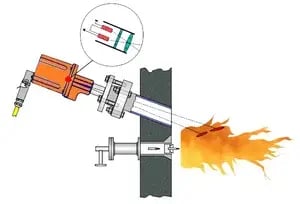
Fiber optic detection technology solved this by removing electronics from the heat entirely. Instead of housing sensitive components at the burner, a heat-resistant fiber optic cable acts as a light conduit, carrying the flame's signal from the burner to a scanner mounted in a cooler location on the penthouse or terrace wall. No purge air to fail, no electronics baking at the source—just a reliable path for the signal to travel.
Why This Matters for Operators
Across all three applications, the throughline is consistent: MICA Controls' value isn't in selling a single flame scanner. It's in understanding which detection technology solves which problem, and having the field experience to know the difference before it becomes an expensive lesson.
The outcomes speak for themselves—fewer false trips, lower costs, safer operation, and equipment that survives the environment it's installed in rather than degrading under it. Flame detection failures aren't hypothetical. They carry real consequences in lost production, safety incidents, and equipment damage, and operators who treat scanner selection as an afterthought tend to find that out the hard way.
Getting Flame Detection Right the First Time
Flame detection looks straightforward from the outside: detect a flame, or don't. In practice, it's a deceptively complex engineering problem, and getting it wrong carries serious operational and safety consequences.
MICA Controls' consultative, application-first approach exists because no two fired environments present the same challenges. A crowded HRSG, an acid-gas SRU, and a scorching reformer penthouse each demand a different answer, and finding that answer starts with understanding the process, not defaulting to a spec sheet.
If your fired equipment's flame detection strategy hasn't been reassessed recently, it's worth a second look. Contact the MICA Controls team to discuss what's working, what isn't, and where the right technology could reduce risk and cost on your next project.