
TL;DR: Low NOx burner technology reduces thermal NOx emissions by staging combustion and, in more demanding applications, incorporating flue gas recirculation (FGR) to lower oxygen concentration in the wind box. Retrofitting a low NOx burner often requires larger FD fans, careful ID fan sizing, refractory modifications, and a burner management system (BMS) upgrade to meet code compliance.
Emissions regulations aren't getting any looser. Companies operating boilers, OTSGs for SAGD operations, utility boilers, and HRSGs for power generation all face strict limits on how much NOx their equipment can release into the atmosphere. Falling short of these limits isn't just a compliance headache; it can mean fines, shutdowns, or costly emergency retrofits.
Low NOx burner technology offers a proven path forward. But implementing it isn't as simple as swapping one burner for another. The engineering involved touches combustion dynamics, fan sizing, refractory design, and control systems. Understanding how the technology works, and where the real challenges lie, makes the difference between a smooth retrofit and a project that stalls out halfway through.
What is low NOx burner technology and how does it work?
Implementing a low NOx burner means refiring the fired equipment: replacing the burner technology with a design that slows down combustion to produce less thermal NOx. Thermal NOx forms when nitrogen and oxygen in the air react at high flame temperatures, so the central engineering goal is de-intensifying the flame without sacrificing combustion efficiency.
Low NOx burners accomplish this through jets built into the burner assembly that stage combustion. Instead of burning all the fuel and air together in one intense reaction, staged combustion breaks the process into phases, slowing the reaction rate and lowering peak flame temperature. Lower flame temperature means less thermal NOx formation.
For many natural gas applications, this staging alone is enough. Retrofitting the burner with staged combustion jets can bring NOx emissions within regulatory limits without any additional equipment changes.
When is burner staging not enough to control NOx emissions?
Staging works well for natural gas, but it hits its limits in applications burning waste products such as ethylene, vinyl acetate, or various purge gases common in industrial settings. These fuels often produce flame intensities too high for staging alone to control. When that's the case, flue gas recirculation becomes necessary.
Choose burner staging alone if you're working primarily with natural gas and need to meet moderate NOx reduction targets. Choose staging combined with flue gas recirculation if you're burning waste gases or have aggressive emissions targets that staging alone can't reach.
What is flue gas recirculation and why does it reduce NOx emissions?
Flue gas recirculation (FGR) takes a slipstream of the exhaust products from combustion and mixes them with fresh air entering the wind box. This dilutes the oxygen concentration in the air charge, typically from around 21% down to approximately 18% oxygen.
That reduction matters because lower oxygen density increases the space between oxygen molecules in the air charge. As that oxygen flows through the burner and mixes with fuel, it oxidizes the fuel more slowly, which further reduces thermal NOx generation on top of the gains already achieved through staging.
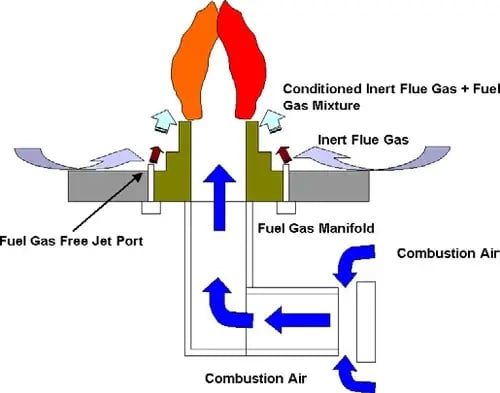 Zeeco Low NOx FREE JET® Schematic
What equipment changes does flue gas recirculation require?
Adding flue gas recirculation isn't a drop-in modification. It changes the mass flow requirements throughout the entire combustion system.
Because FGR introduces additional inert gas (the recirculated flue gas) into the wind box, the forced draft (FD) fan must push more total mass flow while still delivering the same amount of oxygen needed to maintain production. In practice, this usually means the FD fan needs to be sized larger than it would be for a conventional burner.
That increased mass flow doesn't disappear after combustion. As it exits through the induced draft (ID) fan, some systems discover they've become ID fan limited, meaning the existing ID fan can't handle the additional volume without upgrades. Engineering teams need to run mass and energy balance calculations and process simulations before implementation to correctly size both FD and ID fans for the new combustion conditions.
Why do low NOx burner retrofits trigger code compliance requirements?
Cutting new burners into an existing boiler isn't purely a mechanical exercise. It requires an engineering company capable of designing burner placement, specifying refractory modifications to the wind box plate facing the boiler's interior, and managing the structural implications of where the new burners are mounted.
This work typically triggers a code compliance review for the boiler, which in turn requires an upgrade to the burner management system (BMS). Companies evaluating a low NOx retrofit should expect that the scope will extend beyond the burner itself into controls and safety systems governed by current code requirements.
Planning a low NOx retrofit that actually works
If your facility is evaluating a low NOx burner retrofit, start with a mass and energy balance review before committing to equipment. That single step reveals whether your existing fans, refractory, and controls can support the change, or where the real investment needs to go.
MICA Controls operates as a single point of engineering responsibility for these projects, handling burner selection and integration, FGR design, FD and ID fan sizing, and the design of burner management systems and combustion controls across PLC, SIS, and DCS platforms. Companies facing tightening NOx limits don't need to piece together a solution from multiple vendors. They need a team that understands how every component of the combustion system interacts, from the flame itself to the control room.